

Unified Digital Resilience Framework
One line of sight from obligation and risk to capability, evidence and measurable improvement.
Universities operate across an increasingly complex landscape of cyber threats, regulatory obligations, technology dependencies, information risk and institutional change.
Traditional assessments can identify weaknesses. Frameworks can define good practice. Programmes can deliver new controls.
The harder question is:
How do you know the institution has actually become more resilient?
The Expede Unified Digital Resilience Framework (UDRF) connects standards, institutional obligations and material risk to the capabilities, controls, evidence and improvement activity required to manage them.
It provides a structured way to establish a baseline, prioritise investment, guide improvement and demonstrate whether resilience has genuinely changed.
Delivery is not evidence of improvement.
UDRF closes the gap between the two.
From obligation to measurable outcomes
A single, connected resilience methodology
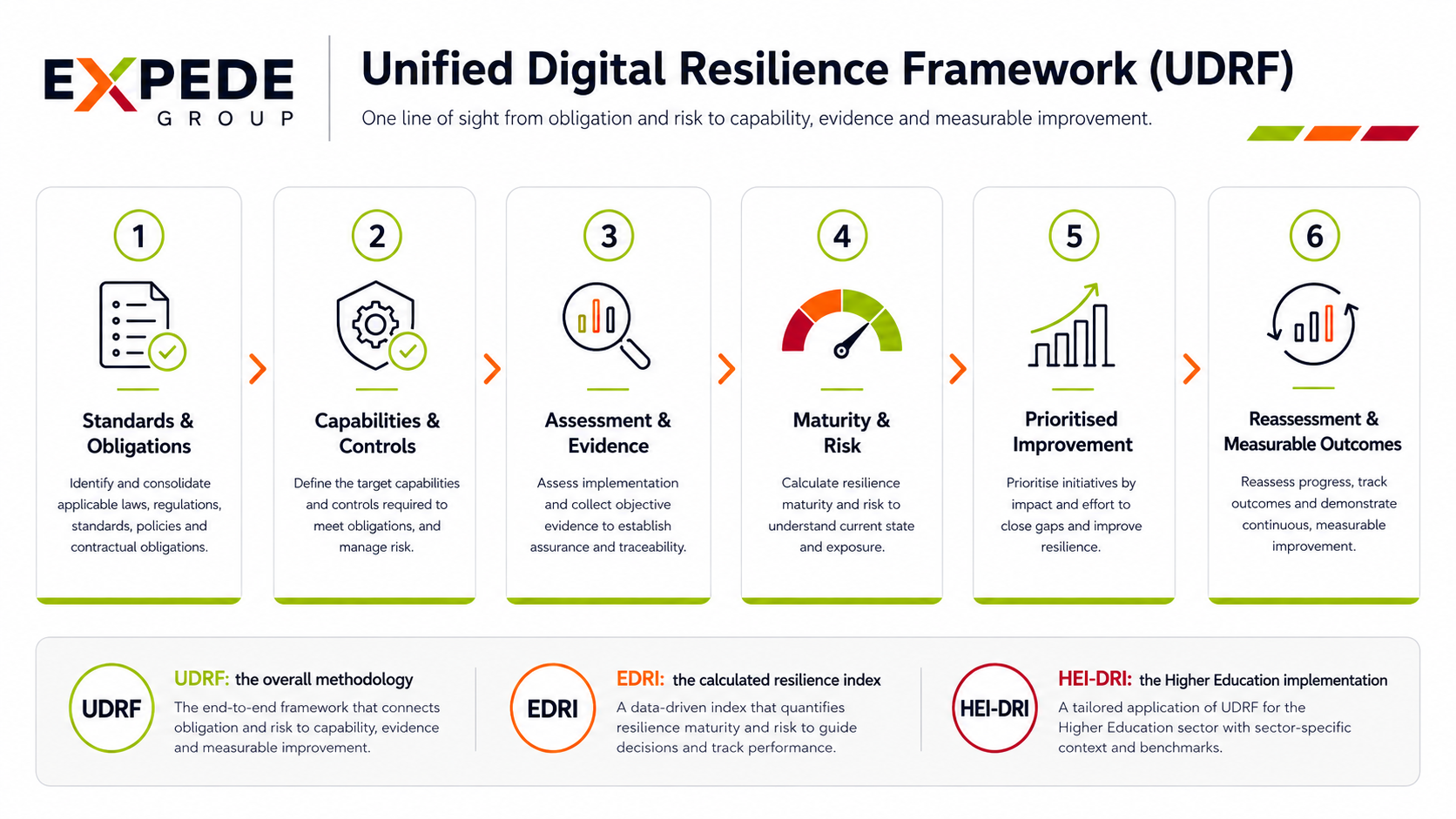
UDRF brings together elements that are often managed separately.
Standards & Obligations
Relevant regulatory, sector, contractual and good-practice requirements are mapped into a common institutional model rather than assessed as disconnected compliance exercises.
Capabilities & Controls
Requirements are translated into the practical governance, people, process and technology capabilities an institution needs to operate effectively.
Assessment & Evidence
Structured assessment questions establish how capabilities operate in practice and capture evidence to support - or challenge - the stated position.
Maturity & Risk
Assessment results are translated into a clearer view of maturity, control effectiveness, material exposure and institutional resilience.
Prioritised Improvement
Identified gaps become prioritised, sequenced improvement activity aligned to risk, dependencies, institutional capacity and available investment.
Reassessment & Outcomes
Subsequent assessments test whether capability has actually improved and provide evidence of movement from the original baseline.
How UDRF Works
Understand. Evidence. Improve. Assure.
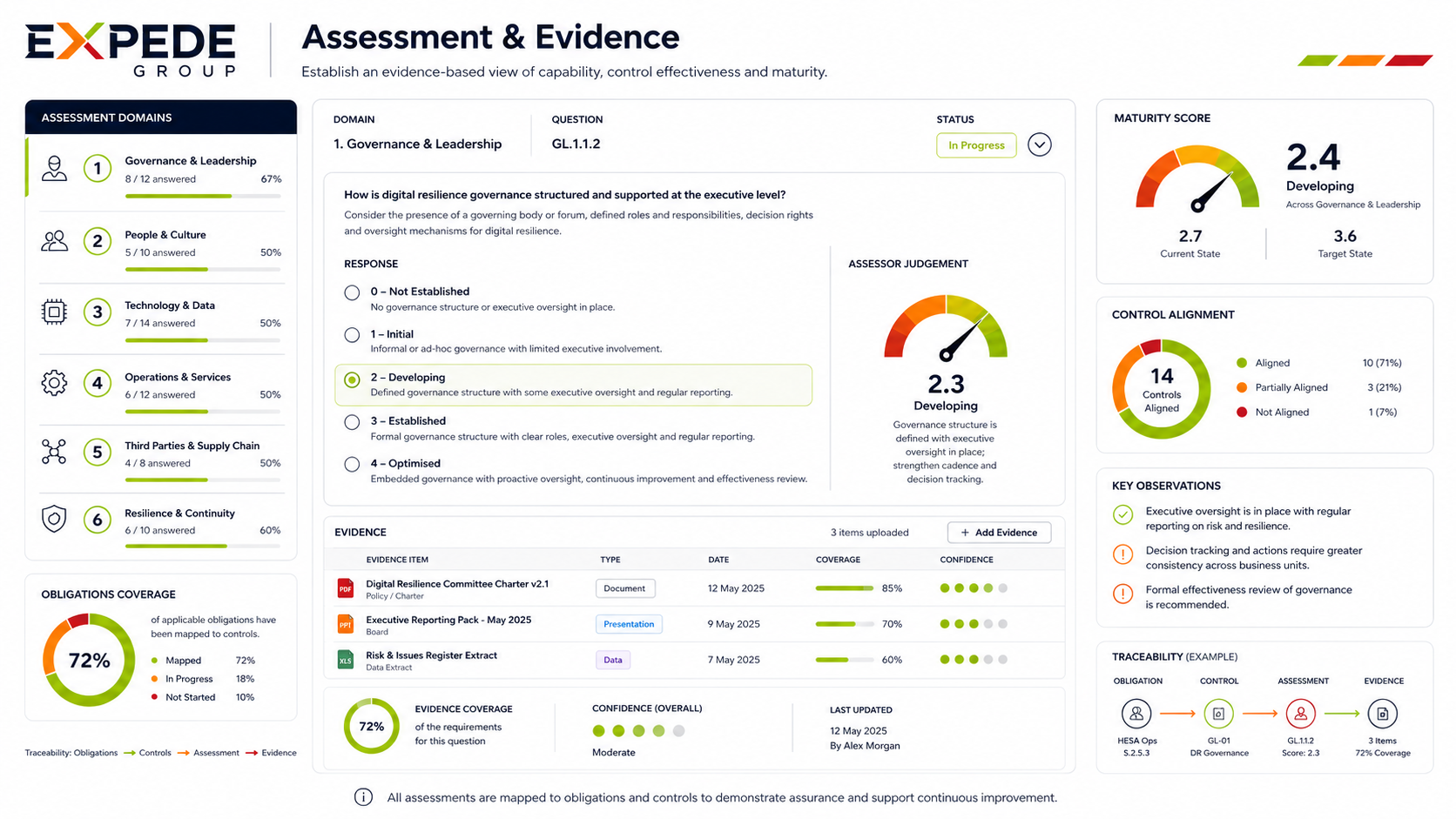
The first UDRF assessment establishes the institution's resilience baseline.
Rather than relying solely on questionnaires or self-declared maturity, the methodology brings together structured assessment, supporting evidence, assessor judgement, institutional context and relevant risk.
That creates a defensible current-state view from which improvement can be prioritised.
As capability is developed, the same model can be used again to reassess the institution - allowing leaders to see not simply what has been delivered, but what has actually changed.
1. Understand
Define scope, obligations, critical services, material risks and the capabilities that matter to the institution.
2. Evidence
Assess how those capabilities operate in practice and gather appropriate evidence of control design, implementation and effectiveness.
3. Improve
Translate gaps into a prioritised and sequenced roadmap aligned to risk, dependencies, resources and institutional capacity.
4. Assure
Reassess capability, evidence and risk to demonstrate improvement, identify residual exposure and determine what should happen next.
Reporting, Roadmaps & Risk Movement
Turn assessment into decisions.
The value of assessment is not the score.
It is the ability to understand what the institution should do next.
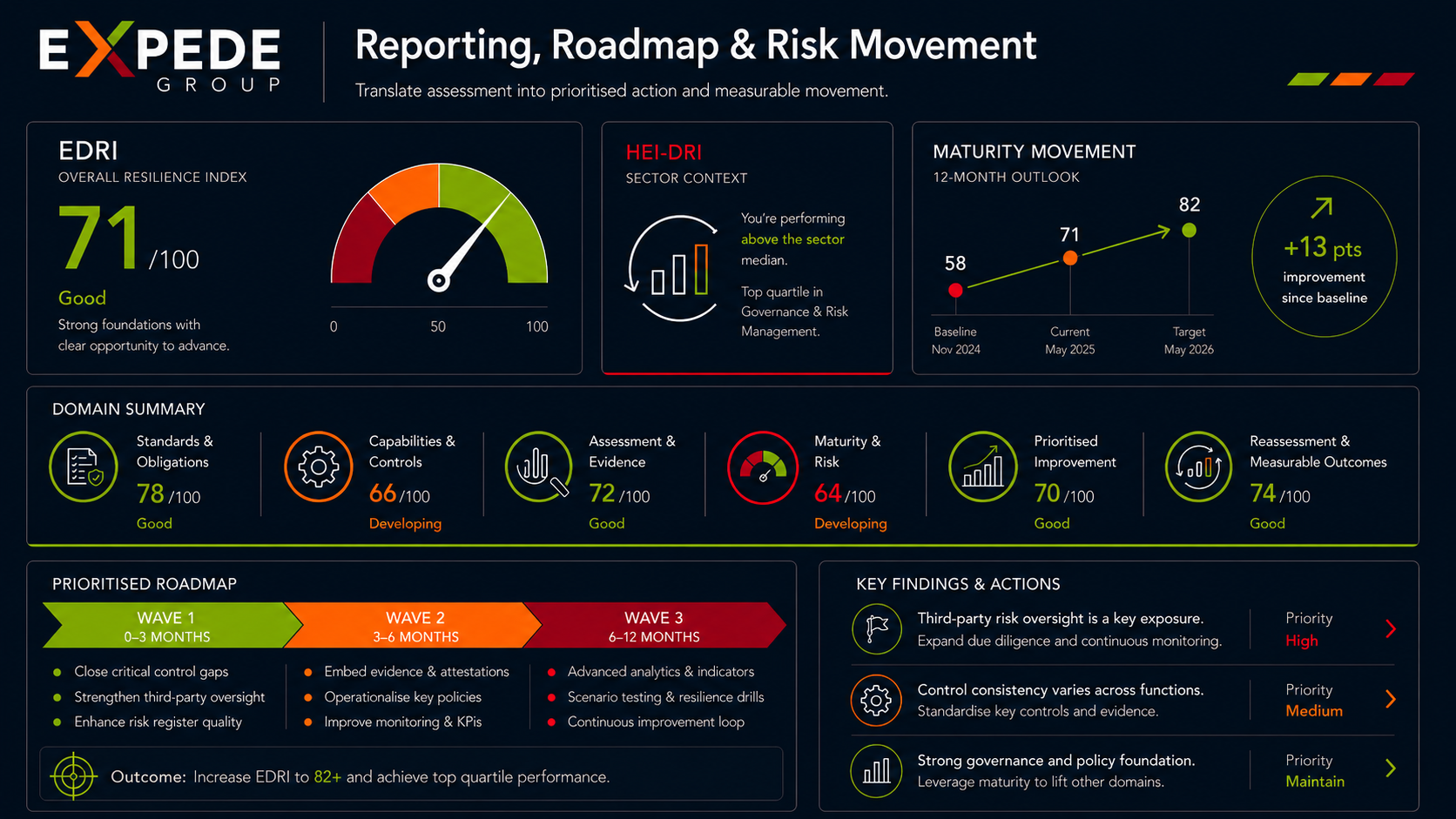
UDRF connects identified capability gaps to material risk and improvement activity, allowing institutions to create a prioritised roadmap rather than a flat list of recommendations.
Improvement can be organised into realistic delivery waves reflecting:
material risk;
critical dependencies;
control weakness;
maturity;
institutional priorities;
available capacity;
existing programmes;
investment requirements; and
delivery sequencing.
Subsequent reassessment then provides evidence of whether those activities have strengthened capability and changed the institution's resilience position.
UDRF, EDRI & HEI-DRI
One framework. Different levels of insight.
UDRF
Unified Digital Resilience Framework
The underlying methodology and capability model connecting obligations, controls, evidence, maturity, risk and improvement.
UDRF is designed to be extensible so that different regulatory, sector and organisational requirements can be mapped into a consistent resilience model.
EDRI
Expede Digital Resilience Index
The calculated resilience index derived through the UDRF methodology.
EDRI provides an executive-level view of resilience while retaining traceability back to the underlying capabilities, evidence, findings and risks from which it is derived.
HEI-DRI
Higher Education Digital Resilience Index
The Higher Education implementation of the UDRF and EDRI methodology.
HEI-DRI applies the common resilience model within the particular context of universities - including complex governance, research environments, distributed technology ownership, critical academic and administrative services, information assets and extensive third-party dependency.
This allows institutional resilience to be assessed consistently without losing the characteristics that make Higher Education different.
What UDRF Connects
More than a maturity assessment

Standards & Obligations
Bring different regulatory, sector and good-practice requirements into one coherent model.

Policies & Governance
Connect institutional policy and accountability to the capabilities and controls required to put intent into practice.

Capabilities
Describe what the institution needs to be able to do to manage digital risk effectively.

Controls
Define the safeguards, processes and operating practices supporting each capability.
Assessment
Use structured questions to understand how capability operates across the institution.
Evidence
Capture evidence that supports, qualifies or challenges the assessed position.
Maturity
Establish how consistently and sustainably capabilities operate in practice.

Risk
Relate capability weakness and control effectiveness to material institutional exposure.

Roadmaps
Translate gaps into prioritised and sequenced improvement activity.

Outcomes
Reassess capability and evidence to show what has genuinely changed.
A holistic view of institutional resilience
UDRF is designed to look across the interconnected capabilities on which digital resilience depends, including:
- Governance, risk and assurance
- Information asset governance and protection
- Identity and access management
- Network security and resilience
- Cloud security and resilience
- SaaS and application resilience
- Endpoint, vulnerability and configuration management
- Security monitoring, detection and response
- Critical-service continuity, crisis management, recovery and operational resilience
- Third-party and digital supply-chain resilience
- Research and sensitive information protection
- Culture, skills, accountability and organisational capability
These areas are not treated as isolated disciplines.
UDRF considers how they work together to protect the services, information and institutional outcomes that matter.